Lecture
Lasers in Cataract Surgery: Femtosecond Lasers and Nanolasers—Evidence Versus Marketing Claims
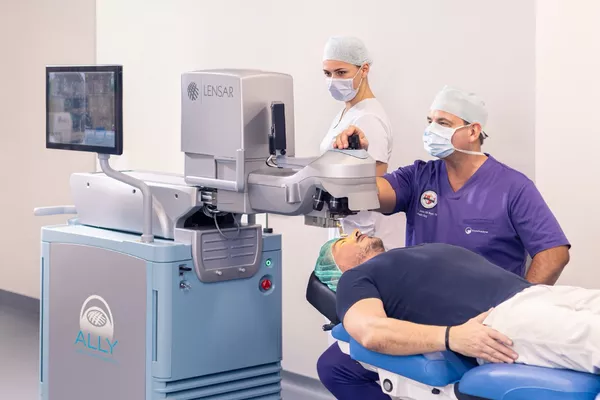
Laser surgery for cataracts is becoming increasingly common. But which laser should be used—a femtosecond laser or a nanosecond laser—and what are the differences? In his presentation, Dr. Detlev R.H. Breyer examines the scientific evidence and compares it with the marketing claims made for each type of laser.
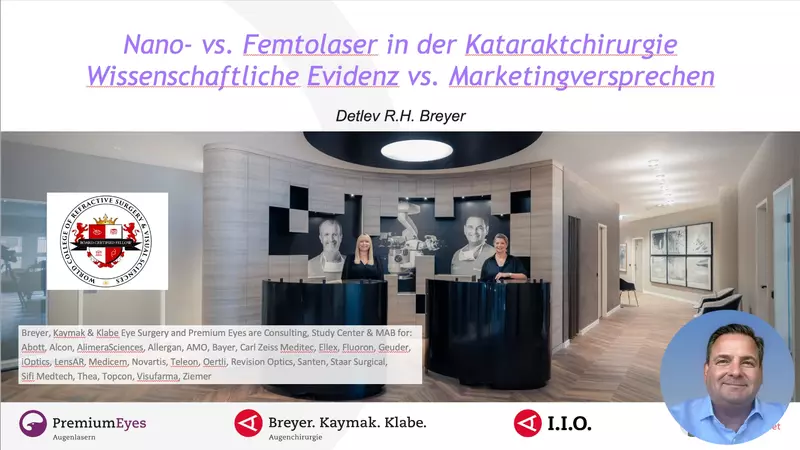
The presentation is aimed at medical professionals, but it is also helpful for patients who are about to undergo cataract surgery and would like to have this very question answered. In it, Dr. Detlev Breyer explains the technical specifications and how the lasers work, addresses the marketing claims, and examines the scientific evidence supporting—or refuting—those claims. He concludes by offering his assessment and recommendation regarding the use of lasers.
The Chapters of the Lecture
Technology Basics
Marketing Claims vs. Reality
Clinical Evidence in Cataract Surgery
Femtolaser: The Gold Standard of Evidence
A Critical Assessment of the Nanolaser
Summary
Nanolasers, Femtosecond Lasers, and Phaco Systems in Cataract Surgery – Fundamentals
Nanolasers and femtosecond lasers differ significantly in terms of their function: The nanolaser liquefies the eye’s lens and is therefore an alternative to the gold standard, phacoemulsification. The femtosecond laser performs many steps that would otherwise be carried out manually by the surgeon, with the highest level of repeatable precision.
Phacoemulsification
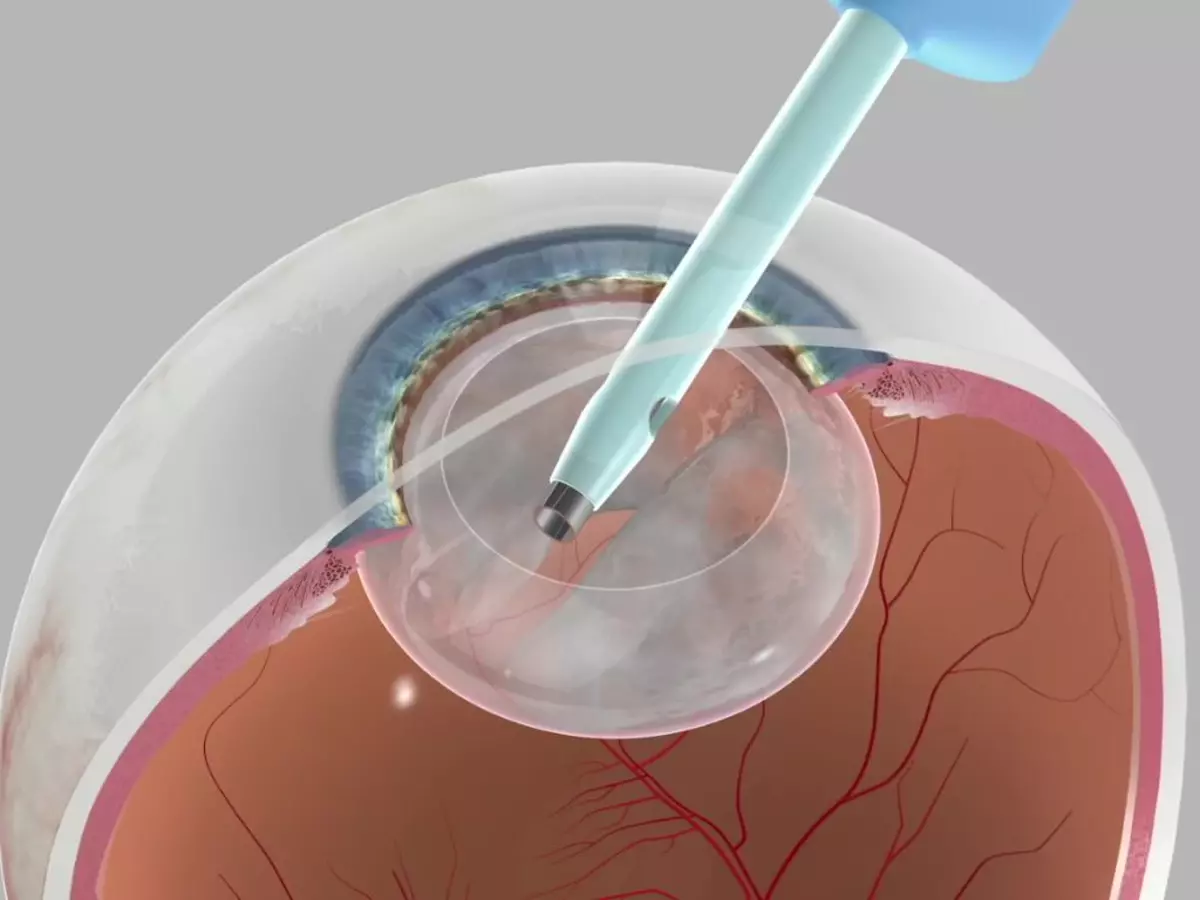
Cataract Surgery Using the Small-Incision Technique and Phacoemulsification
Cataract surgery using phacoemulsification is considered the gold standard. The procedure begins by creating a tiny incision at the edge of the cornea. The surgeon then makes a circular incision in the lens capsule (capsulorhexis). Using state-of-the-art technology, the cloudy interior of the lens is gently broken up and aspirated using ultrasound energy (phacoemulsification). Finally, the surgeon uses a fine instrument to insert the rolled-up premium lens into the capsular bag, where it unfolds on its own. No sutures are required. The lens remains in the eye for life.
The Nanolaser
In cataract surgery, the nanosecond laser is used exclusively to liquefy the interior of the lens. This is achieved through photodisruption within a 2-mm near field around the probe. In principle, it therefore replaces phacoemulsification, in which the clouded lens is liquefied using ultrasound. This process takes a few minutes—depending on the hardness of the lens nucleus. In our experience, the nanolaser is effective for soft to moderately hard nuclei, but not for hard nuclei. The local energy input is 2–30 mJ per pulse.
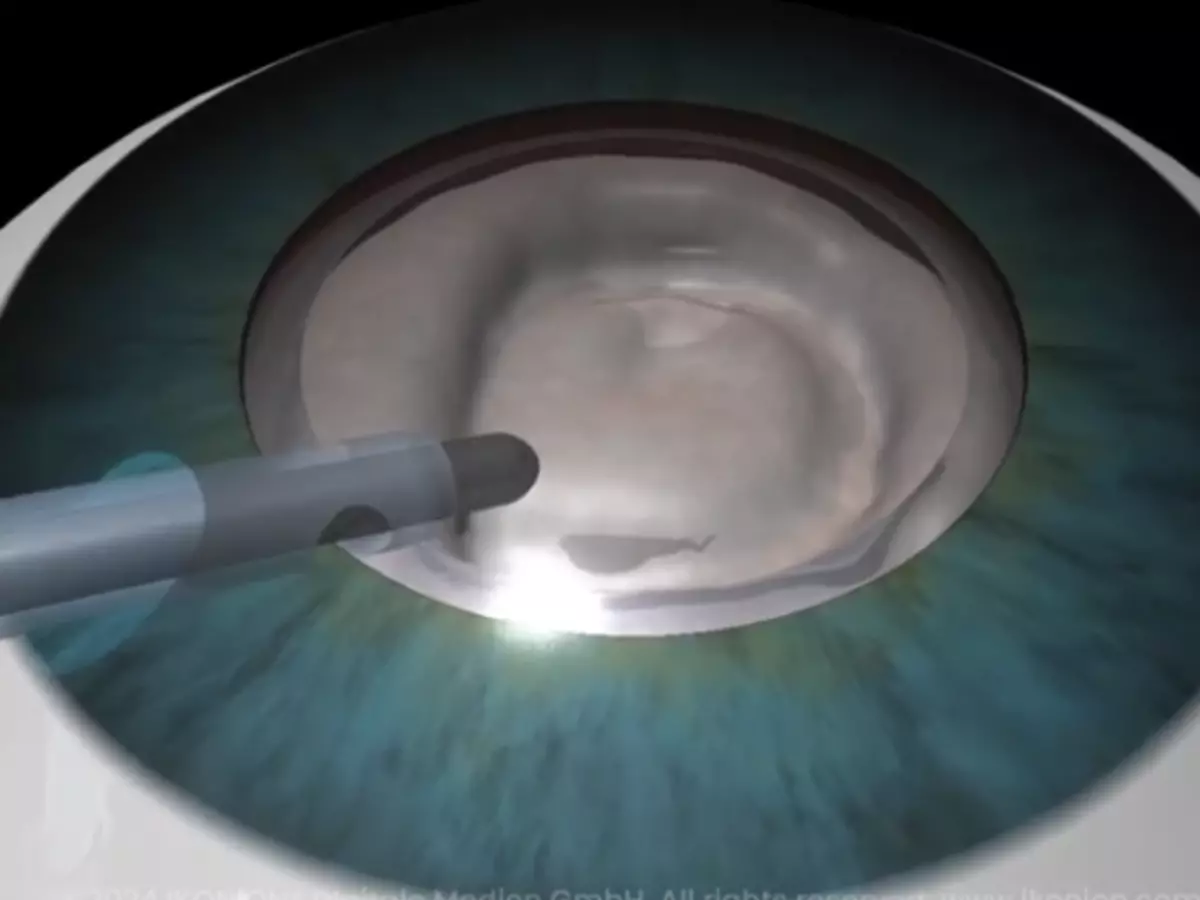
Removal of the interior of the lens using a nanolaser.
The Femtosecond Laser
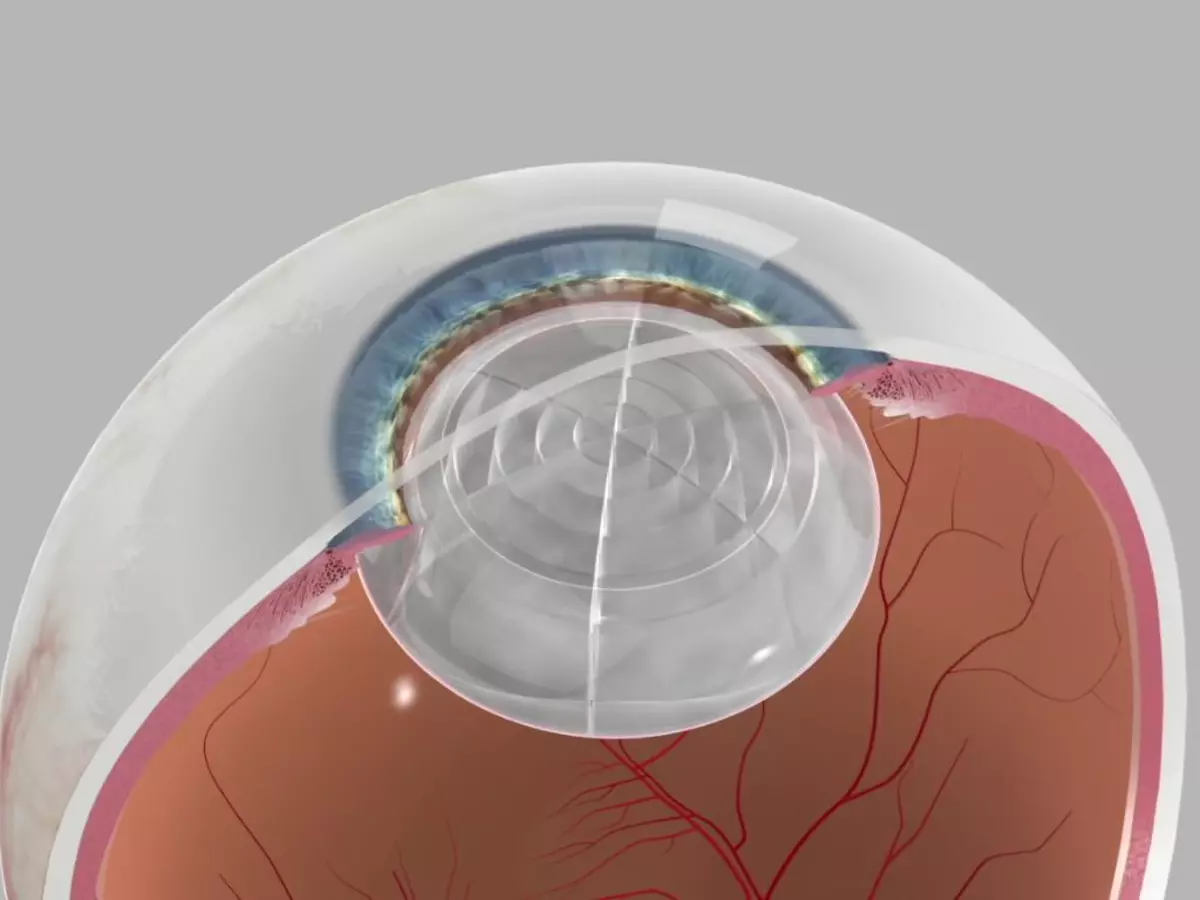
Cataract surgery using a femtosecond laser.
In femtosecond laser-assisted cataract surgery, the laser creates a circular incision in the lens capsule, fragments the lens nucleus regardless of its hardness, makes arc-shaped incisions for mild cases of astigmatism, or—in cases of more severe astigmatism—marks the toric axis along which a toric lens can be precisely aligned. All of this takes just one minute. Its operating principle is photodisruption through plasma generation with a precision of <1 µm; its energy input is in the nanojoule range—which is lower than that of a nanolaser.
The femtosecond laser adapts the fragmentation pattern to the density of the lens nucleus. This facilitates subsequent removal using ultrasound and is gentler on the eye. On some devices, this step can also be performed directly on the femtosecond laser.
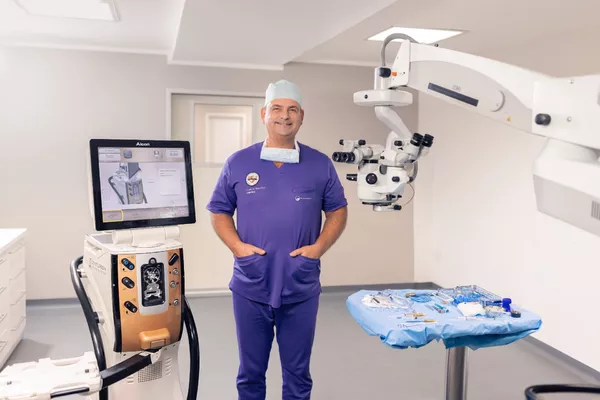
The femtosecond laser we use at Premium Eyes was developed specifically for cataract surgery. It features 6 HR Scheimpflug cameras for mapping the eye’s structures. Its software can also digitally transmit the results from the preliminary examination to the laser via Wi-Fi and compare them with the live image of the eye. This enables a very high and repeatable level of precision, as well as customized treatments for refractive cataract surgery—that is, with the goal of eliminating the need for glasses.
After using the femtosecond laser, our high-volume surgeons need less than 1–2 seconds (not minutes) to perform phacoemulsification—that is, to aspirate the pre-fragmented lens. To achieve this, we use an intelligent phaco system with active intraocular pressure control, meaning that intraocular pressure remains stable and the anterior chamber is maintained. This is particularly gentle on the eyes and reduces risks.
Marketing Claims Under the Microscope
You can find the detailed answers, including the scientific evidence, in the presentation above.
-
There are no randomized controlled scientific studies (RCS) that demonstrate superiority over the standard procedure, phacoemulsification.
-
This was demonstrated in a U.S. study comparing the procedure to phacoemulsification, but not in a randomized cohort. — Therefore, this statement is only valid to a limited extent.
If we compare the data on endothelial cell loss (the lower the number, the better):
For ultrasound, the figure is 20.2%
With the nanolaser, it is 12.7%. Important: The data are based on small, non-blinded cohort studies.
With the femtosecond laser FLACS: consistently reduced, g=0.26 across 14 studies
Femtolaser plus nanolaser achieve 7%; see presentation for
references
-
It is true that there is less thermal damage than with phacoemulsification. However, this is no longer the case once the nucleus hardness reaches 4. Furthermore, the combination of femtosecond and nano lasers yields better results than the nano laser alone.
-
Perhaps each eye surgery center should decide that for itself.
-
Another hygienic advantage mentioned is the disposable handpiece, which is also available for phacoemulsification. And, of course, the patient interface of the ALLY laser—which comes into contact with the patient’s eye—is a sterile, disposable component used for only one eye.
Evidence: Are these marketing claims substantiated?
There are significant gaps in the scientific understanding of nanosecond lasers, and only a few proven advantages over the standard ultrasound procedure (phacoemulsification). In contrast, there is strong scientific evidence supporting the use of femtosecond lasers. You can find more details on this in the presentation.
Summary
The nanolaser is used to liquefy the interior of the eye’s natural lens. It is therefore an alternative to phacoemulsification, which uses ultrasound energy. Phacoemulsification is considered the gold standard and is a scientifically well-documented procedure.
There are no randomized controlled trials (RCTs) for the nanolaser procedure, nor are there any that demonstrate its superiority over the standard procedure, phacoemulsification.
There is strong scientific evidence supporting the use of the femtosecond laser in refractive cataract surgery for all degrees of nuclear hardness. It enables short surgical times and is particularly suitable for patients with the highest expectations.