Laser Eye Surgery
SMILE® pro Xtra: Greater Safety in Laser Eye Surgery for Thin Corneas

Don't risk any complications with laser eye surgery
Safety comes first—and that applies to laser eye surgery as well. That’s why many laser eye surgery procedures reach their limits when dealing with thinner corneas and/or high myopia (nearsightedness), especially when combined with astigmatism. With SMILE pro Xtra, a combination of SMILE pro and accelerated cross-linking (CXL), we can correct higher degrees of refractive error while simultaneously stabilizing the cornea. This allows us to minimize the risk of corneal weakening in cases of higher risk or when there is uncertainty. This gives you added peace of mind.
Who is SMILE pro Xtra suitable for?
Although SMILE pro only slightly alters the biomechanical stability of the cornea compared to other laser eye surgery procedures, some people are at a higher risk than others of developing corneal weakening.
An important factor is the ratio of corneal thickness to the degree of refractive error. This is because during laser eye surgery to correct nearsightedness (myopia), the central part of the cornea is flattened. The thinner the cornea and/or the more severe the refractive error, the greater the risk of corneal weakening (keratectasia) following laser eye surgery. This leads to a bulging of the cornea similar to that seen in keratoconus. Although both conditions can be treated in their early stages with iontophoresis cross-linking (iCXL), it is best to prevent them from occurring in the first place.
Unusual corneal topographies are another risk factor for such corneal weakness.
Of course, we will assess your risks as part of a thorough preliminary examination and discuss them with you.
Dr. Detlev R. H. Breyer
Studies have shown that, for high-risk patients or in cases of uncertainty, it is advisable to perform a painless, accelerated crosslinking procedure immediately after SMILElaser eye surgery to stabilize the cornea and thereby reduce the risk of protrusion—as a preventive measure.1,2,3
Confocal microscopy 6 months after treatment showed no changes in the corneal endothelium.4
SMILE pro Xtra with accelerated crosslinking (CXL) in a single procedure
SMILE pro Laser
Eye Surgery In the first step, we perform the SMILE pro procedure using the VISUMAX 800 femtosecond laser (ZEISS). During this process, the laser creates a lenticule inside the cornea as well as a tiny opening. Through this opening, the surgeon removes the lenticule using a special instrument to correct the vision defect.'Xtra': Accelerated Pain-Free Crosslinking (CXL)
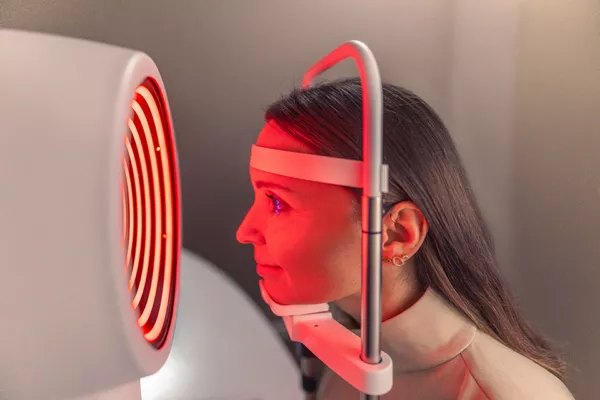
Immediately afterward, the surgeon administers vitamin B2 (0.25% riboflavin in saline solution) directly into the corneal pocket from which the lenticule was previously removed and allows it to take effect for approximately 60 seconds. The eye is then exposed to UV-A light for approximately 75 seconds to activate the riboflavin: it forms tissue bridges within the stroma that stabilize the tissue.
Schedule an appointment
The accelerated cross-linking procedure takes about three minutes in total. It is completely painless, safe, and results in a very rapid recovery of vision.
Dr. Detlev R.H. Breyer