
Lens Method
Here's How Your Lens Treatment at Premium Eyes Works
Here you’ll find a step-by-step overview of the treatment process for lens procedures—such as Implantable Contact Lenses (ICL) or refractive lens exchange—from your initial consultation through your follow-up visit. Don’t worry—we perform all procedures using minimally invasive techniques and state-of-the-art technology. The procedure is painless for you.
Step 1
Your First Contact with Premium Eyes
Are you planning to have laser eye surgery to stop wearing glasses and would like to learn more about how the procedure works at our clinic? Feel free to schedule an appointment for a free initial consultation. Book your appointment online here on our website, by phone, or via WhatsApp. We look forward to hearing from you and meeting you!
Schedule an appointment
Step 2
Non-binding Initial Consultation for Lens Implants

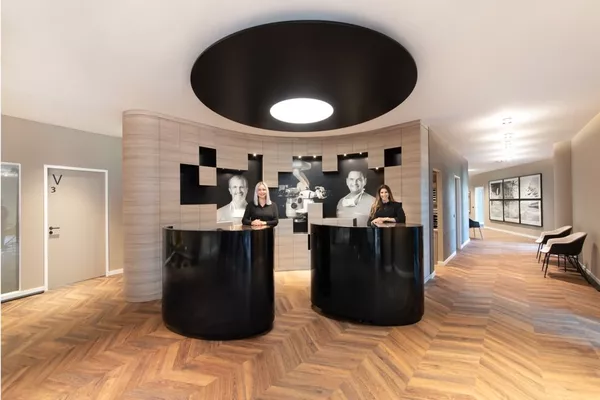
The initial consultation (with no obligation) and preliminary examinations—including all consultations—as well as follow-up visits take place at our practice located at Martin-Luther-Platz 26, 40212 Düsseldorf, on the 5th floor.
Step 3
A thorough preliminary examination and personalized consultation
How to Prepare
Please refrain from wearing contact lenses for two to three weeks before the preoperative examination so as not to compromise the final visual outcome of your treatment. You can find more detailed information on this topic on the page about the preoperative examination before lens surgery.
Please come to the preliminary examination at our office with someone accompanying you, as you will not be allowed to drive yourself afterward. Please allow 3–4 hours for all examinations, including the consultation.
The preliminary examination takes about 3–4 hours, during which we thoroughly examine your eyes using various instruments. This allows us to plan your surgery with great precision and rule out any risks.
We’ll also ask you to fill out a medical history form, in which we’ll ask about any known pre-existing conditions and whether you’re taking any medications, as well as which ones. In addition, we’ll ask you a few questions about your visual preferences, your occupation, and your hobbies, all of which are relevant to the requirements for your future visual quality. It’s also important to know whether you frequently drive at night.
Consultation: Following the examinations, our doctors will provide you with a detailed consultation about the procedure and discuss your expectations regarding your future visual quality.
If a lens replacement is planned, we’ll explain your options for selecting premium lenses tailored to your individual needs and provide a recommendation. We’ll inform you about the procedure, the costs, and explain any possible side effects and risks.

Cost Estimates, Information Sessions, and Surgery Appointments
Next Steps: Before treatment, we will provide you with a detailed cost estimate. The cost of the preliminary examination will be applied toward the treatment costs.
If you agree, we’ll schedule an appointment for a preoperative consultation, during which our anesthesiologists will also explain the options available to ensure that the surgery is pain-free for you.
We will then schedule one or two surgery dates—since we generally do not operate on both eyes on the same day, unless you request it and there are no medical reasons against it—as well as all necessary follow-up appointments.
Your Preparation and Follow-up
Your eye drop schedule for before and after your lens surgery
Before the surgery, we will provide you with a medication schedule and a prescription for medications (eye drops or eye ointments). Please read the schedule carefully and use the medications exactly as described in the schedule. If both eyes are being operated on on different days, apply the drops accordingly.
You’ll need to apply some medications before the surgery and others afterward.
If you are prescribed multiple medications, please always wait at least 15 minutes before applying the next one.
By using the medications correctly, you support the healing process and reduce the risk of infection.
If you have any questions, please feel free to contact us at any time. You can also download the eye drop schedules for the various lens surgeries here.
Dosing Schedule (Download) ( 288.81 KB )
Lens
Replacement Schedule (Download)
Step 4
On the day of treatment
The time has finally come: Your (first) laser eye surgery is just around the corner. There’s no need to be afraid—it’ll be over in no time, and you won’t feel any pain. I promise!
Please wear comfortable clothing and avoid wearing contact lenses, makeup, or face creams on the day of your appointment.
Please arrive on an empty stomach; that is, do not eat anything for 6 hours before your surgery appointment and do not drink anything for 2 hours beforehand—except for a small sip, for example, to take medication.
Please come to our main location with a companion and check in at the reception desk on the 5th floor (take the elevator). Ask your companion to take you home after your treatment.
Our staff will prepare you for the procedure, and the anesthesiologists will ensure that the procedure is completely pain-free for you.
The procedure is performed in our hygiene-certified operating room at our main location:
Breyer, Kaymak & Klabe Eye Surgery,
5th Floor
, Martin-Luther-Platz 22, 40212 Düsseldorf
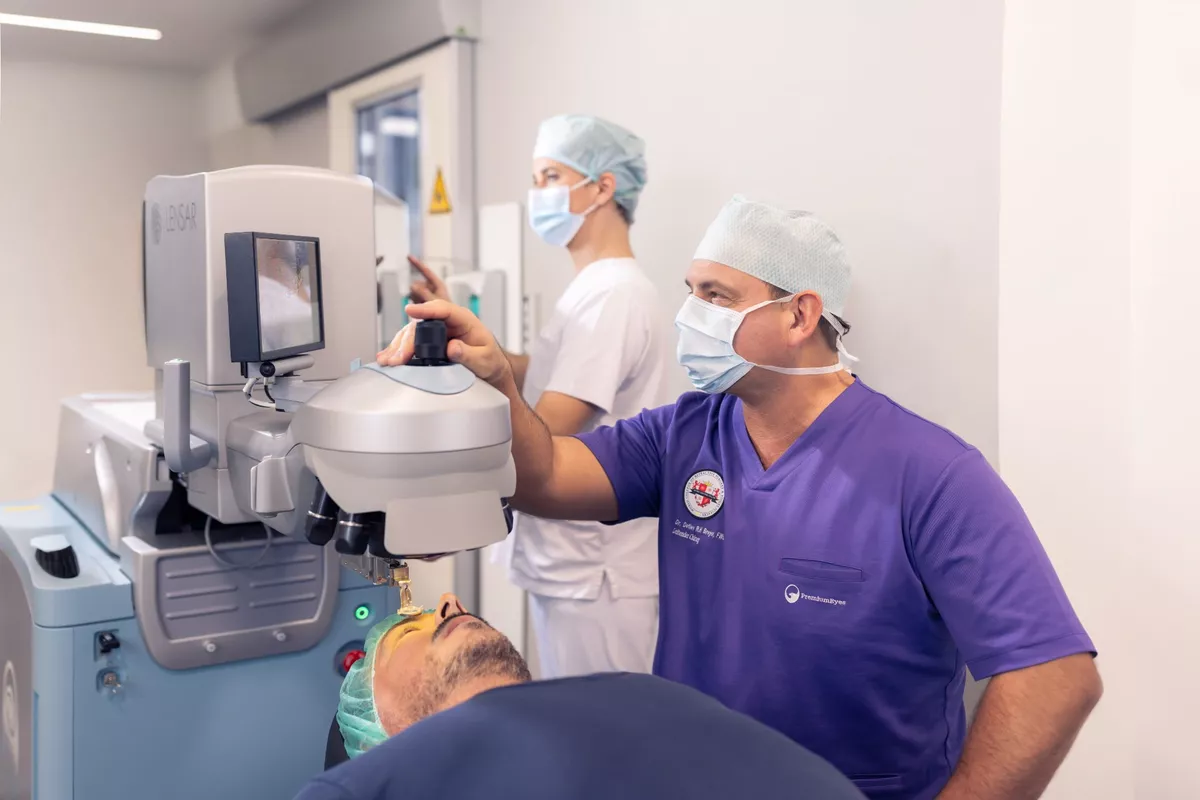
With our experienced surgeons, you're in the best hands.
Before the procedure, your surgeon, Dr. Artz or Dr. Detlev Breyer, will go over the planned procedure with you one more time, and then we’ll get started. During the procedure, they’ll explain each step to you so that you always know what’s coming next.
Depending on the type of lens surgery you’re having, the entire procedure for both eyes takes about 15 to 30 minutes. – And that’s it!
We will provide you with Dr. Breyer's cell phone number. If you experience pain or any other side effects within the first 24 hours after the procedure, please do not hesitate to call him. He is happy to assist you.
Step 5
The follow-up check the next day
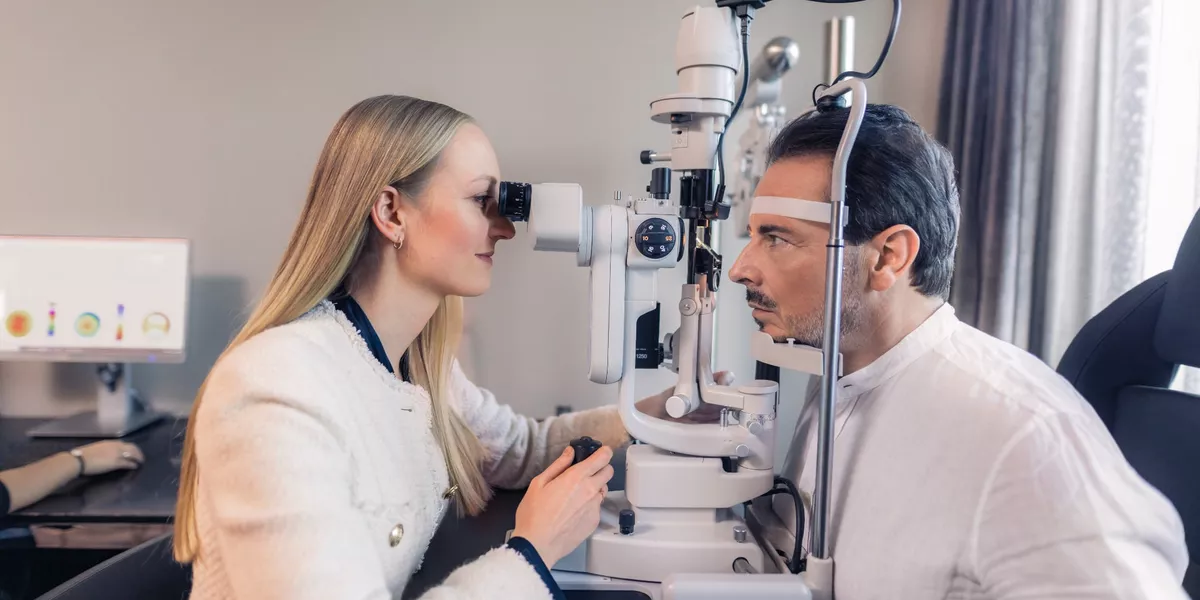
The day after your treatment, please come to our office at Martin-Luther-Platz 26, 5th floor, as previously arranged—unless you were given a different location. There, our doctors will examine your eyes again very carefully using a slit lamp. We may also check your visual acuity on that day. If necessary, we’ll schedule additional follow-up appointments. Otherwise, you’ve made it this far.
Your second eye may be operated on a little later if you did not opt for simultaneous surgery. In that case, please be patient and, for the next few days, continue to use the eye drops and ointments as prescribed so that your eye can recover quickly from the procedure.
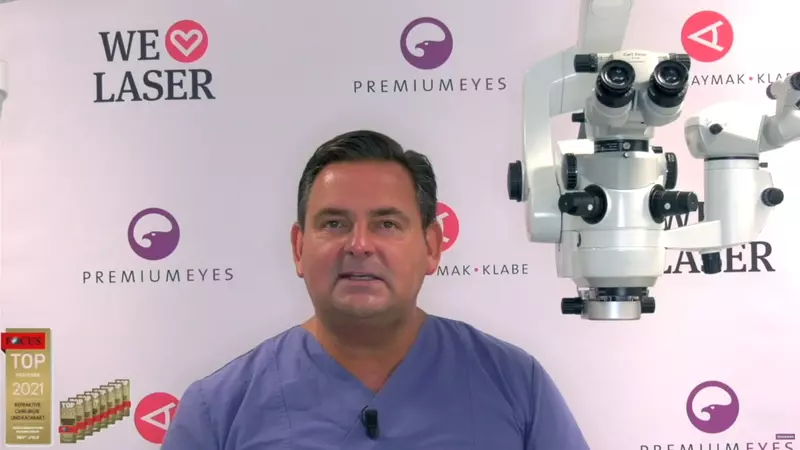
Post-Surgery Care After Lens Surgery
In this video, Dr. Breyer explains how you should care for your eye after lens surgery to ensure it heals properly and to prevent complications, such as:
During the first two weeks after surgery
you should let your operated eye rest as much as possible and avoid touching it.
Follow the eye drop schedule as closely as possible and apply the drops without touching the eye.
When showering or washing your hair during the first few days, make sure that no water, shampoo, or soap gets into the operated eye.
Avoid using creams, lotions, and makeup on your face,
do not rub your operated eye, and
do not apply any pressure to the operated eye.
After this period, you can resume all normal activities.
The duration of this adjustment period (neuroadaptation) to the crossfade visual acuity varies from person to person and can certainly last about three months.
Dr. Detlev R.H. Breyer
When will you achieve the desired visual outcome after the procedure?
That depends on the correction method. For example, if you’ve had nearsightedness, farsightedness—with or without astigmatism—corrected in both eyes using implantable contact lenses, you can achieve the desired visual acuity just a few days after the procedure. After the implantation of multifocal lenses or in the case of transition vision according to the Düsseldorf method, it may take up to three months for your brain to adjust to the new visual experience.
Experiences
Here's what other patients have to say about their lens surgery


Do you have any questions?
If you have any questions about your planned treatment, please feel free to contact us—by phone, email, WhatsApp, or online via doctolib.de. We’d also be happy to call you back. We look forward to hearing from you.