
Age-related farsightedness / Presbyopia
Presbyopia (Age-Related Farsightedness) – An Overview of Symptoms, Causes, and Treatments
Presbyopia affects everyone sooner or later because the eye’s lens becomes thicker and less flexible over the course of a person’s life. As a result, the eye can no longer “focus” properly on nearby objects. Starting around age 45, the increasing farsightedness becomes clearly noticeable, which is why it is also referred to as age-related farsightedness or presbyopia. Presbyopia can be treated with Presby-LASIK or through refractive lens exchange.

Get an overview of the causes and symptoms of presbyopia, traditional correction options, and modern laser eye surgery and intraocular lens procedures that can free you from the need for reading glasses, progressive lenses, or contact lenses. We’d be happy to provide you with a free, no-obligation consultation!
Schedule an appointment for a no-obligation initial consultation.
Origins
How does presbyopia, or age-related farsightedness, develop?
The eye's lens can flexibly increase the eye's refractive power, allowing us to see clearly at both intermediate distances and up close. It is located within the elastic lens capsule and is connected to the ring-shaped ciliary muscle (1) via the zonular fibers (2). In young people, the lens is clear and flexible. When we look into the distance, the ciliary muscle is at rest, the zonular fibers are taut, and the lens is flat.
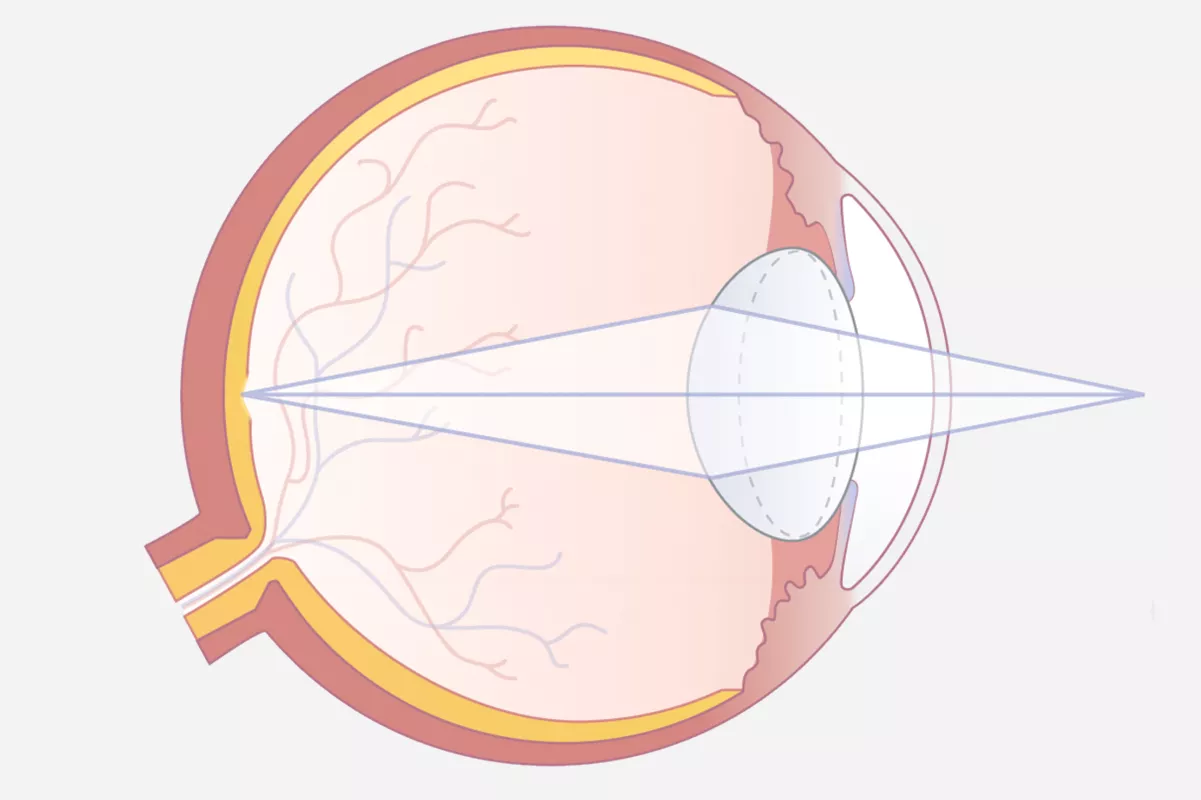
When we focus on something close up, the ciliary muscle contracts, the zonular fibers relax, causing the lens to take on a spherical shape—especially in the front—and move slightly forward. This flexibly increases the eye’s refractive power until the focal point is once again on the retina. This is called accommodation.
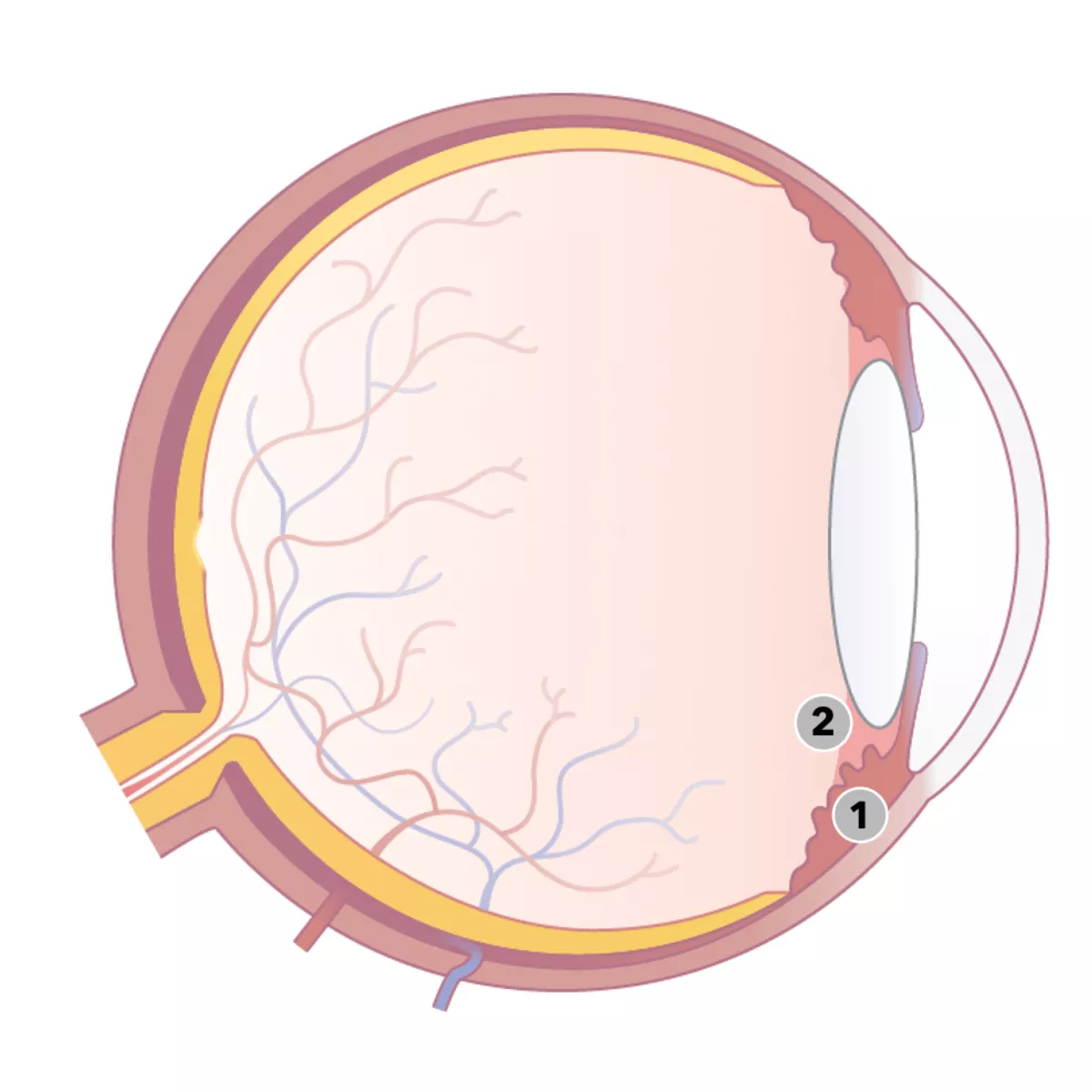
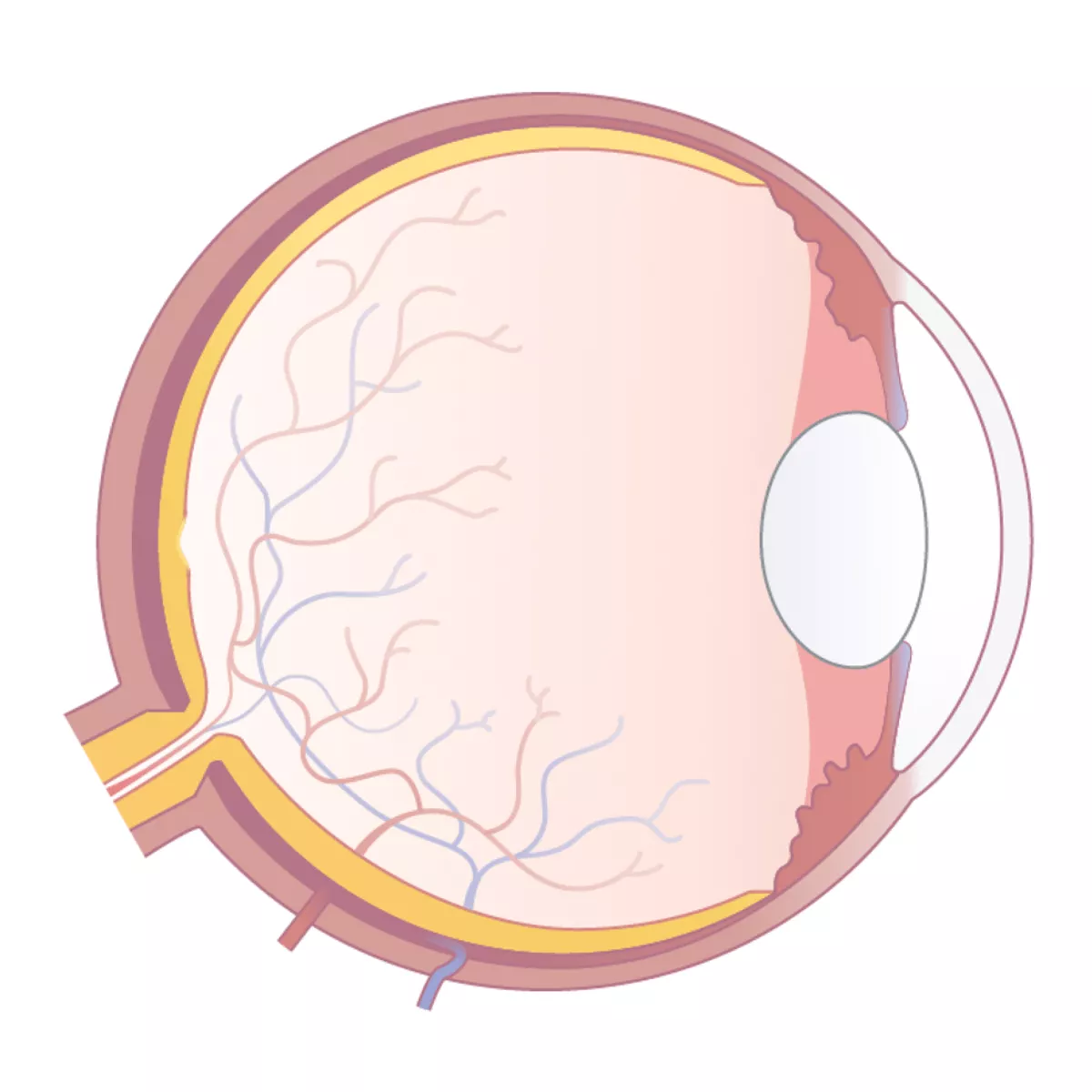
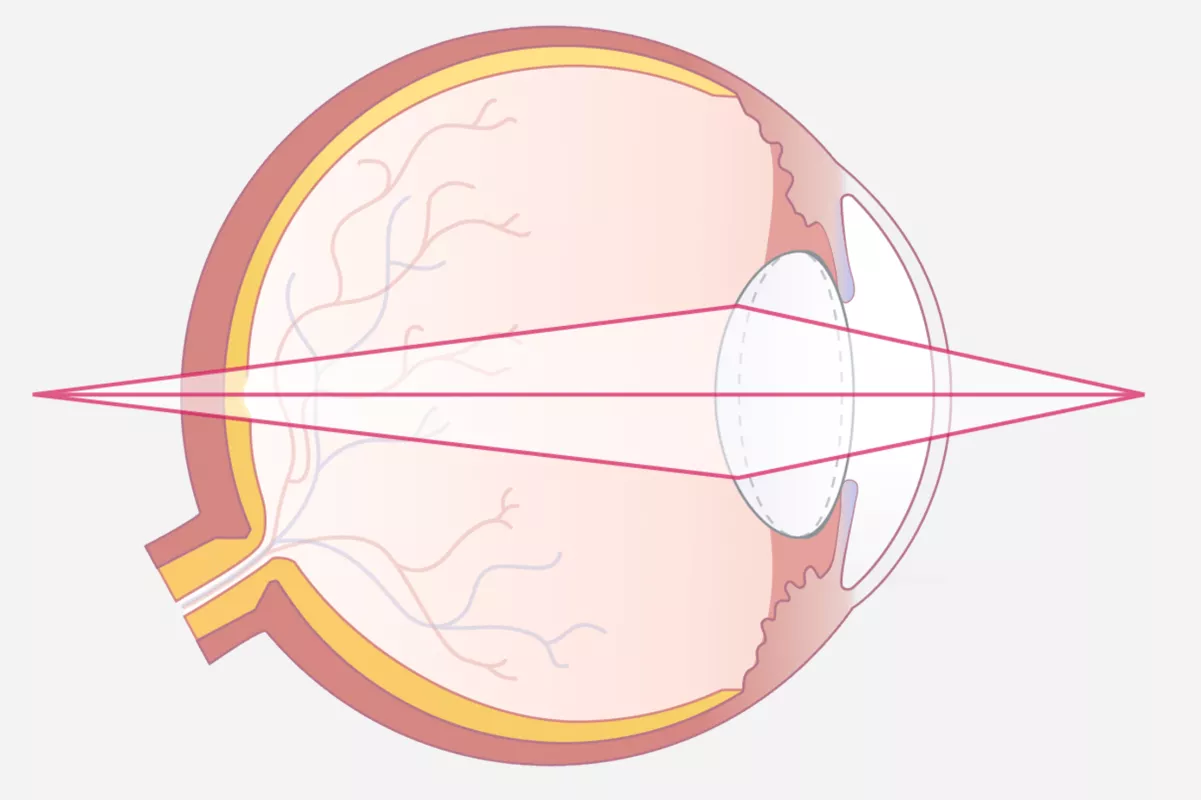
Due to metabolic processes, the interior of the lens becomes stiffer over the course of our lives. As a result, the eye’s ability to accommodate continuously decreases, and the so-called near point—the closest distance at which objects can be seen clearly without correction—moves farther and farther away. Starting around age 45, the eye’s refractive power is no longer sufficient to focus on nearby objects. By around age 65, the near point is approximately 2 meters. This is known as presbyopia.
Symptoms
What are the symptoms of presbyopia, or age-related farsightedness?

Presbyopia begins earlier, but it usually becomes noticeable only between the ages of 40 and 50. If you notice that your near vision is getting progressively worse, these are typical signs of presbyopia:
You have trouble reading small print
it becomes increasingly difficult to see objects clearly at the usual reading distance, such as product labels while shopping or the menu at a restaurant
you hold your smartphone or other objects you want to see clearly up close farther and farther away: your “arms get longer”
Your eyes take longer to adjust to changing lighting conditions—that is, from bright to dark
As you get older, starting around age 60, your distance vision also begins to deteriorate
-

When nearsighted people develop presbyopia, they notice that they can no longer see clearly up close with their distance glasses and take them off, for example, to read news on their smartphone. Eventually, however, they’ll need correction for both near and far vision—at which point progressive lenses can help. But these take some getting used to and aren’t the best solution for everyone in every situation. We’ll inform you about alternatives, such as laser eye surgery for presbyopia or implantable contact lenses.
What is the difference between farsightedness (hyperopia) and presbyopia?
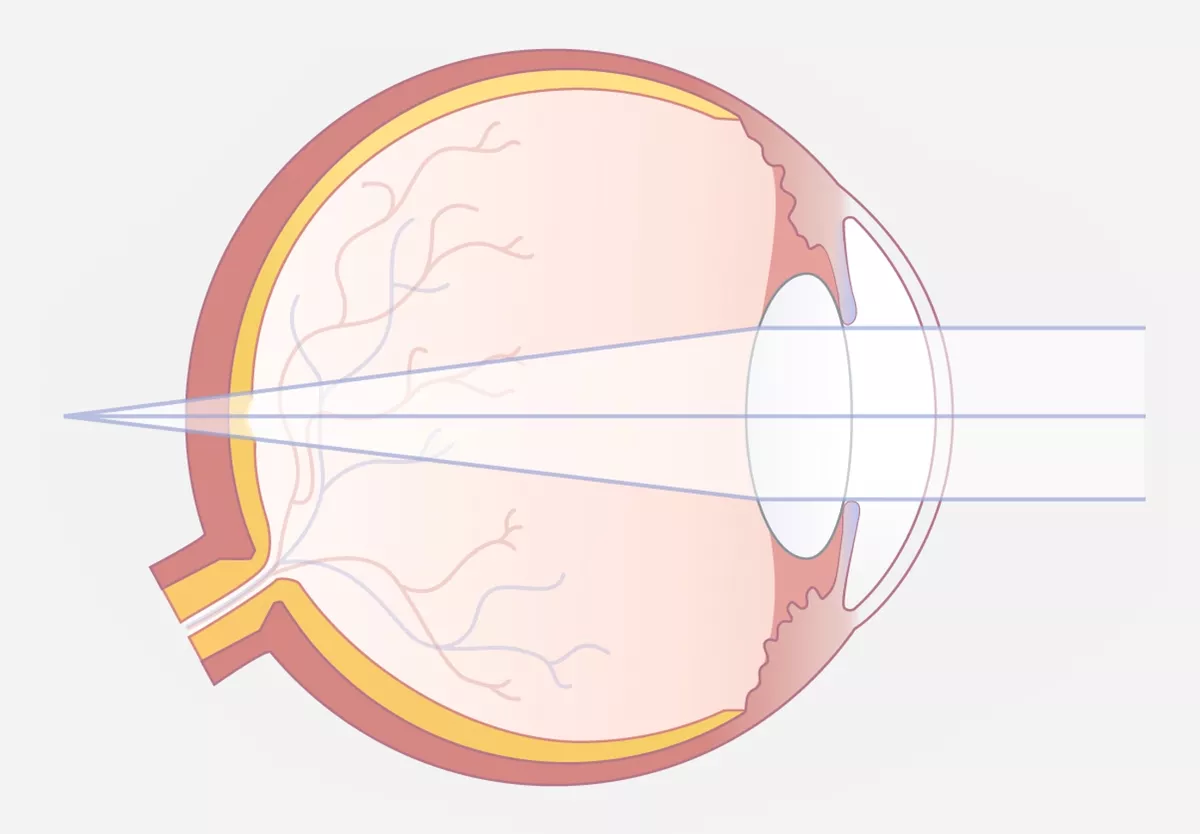
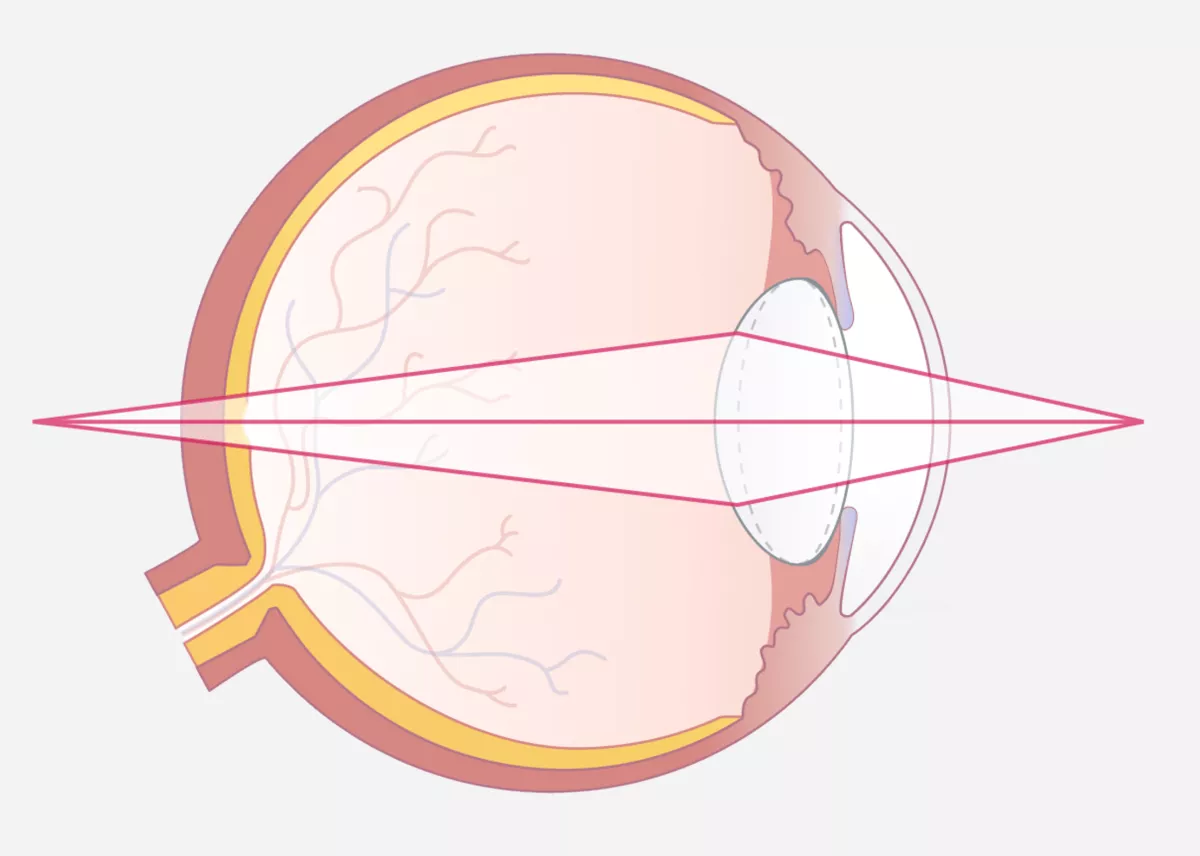
In hyperopia (farsightedness), which can occur even in young people, the eye is too short or the refractive power of the cornea is too low. As a result, when the lens is flat, light rays entering the eye in parallel are focused behind the retina. This happens not only when we want to look at something up close.
In contrast, presbyopia refers to difficulty seeing up close when the lens is accommodated. In older people, the lens can no longer become sufficiently rounded to focus light rays on the retina. This is why their vision is blurry when looking at nearby objects.
Schedule
an appointment now for a free initial consultation.
Traditional Correction
Correcting Presbyopia with Reading Glasses or Progressive Lenses—What Should You Keep in Mind?
Reading glasses or progressive lenses are the traditional corrective options for presbyopia, allowing people to read or see clearly up close. However, as the eye’s lens becomes increasingly less flexible, the prescription for the glasses must be adjusted regularly.

It's not just in tennis that excellent vision—from far away to up close—is essential.
Dr. Detlev R.H. Breyer
Surgical Treatments
Treatments: Laser surgery for presbyopia or lens replacement right away?
Are you planning to have surgery to get rid of your reading glasses or progressive lenses? As with any procedure, the safety of the method should be the top priority. After all, presbyopia is not a disease; the primary goal is to improve your quality of life through better near vision. The goal is to achieve independence from reading glasses or progressive lenses.
If, after a thorough preliminary examination, we determine that your natural lens is still clear and there are no other contraindications for laser eye correction, we generally recommend laser treatment for presbyopia—that is, a correction performed on the cornea. Only when the eye’s lens begins to cloud—and at the earliest age of 50—do we generally recommend refractive lens exchange.
This is because, when comparing the risk profile of laser eye surgery with that of lens surgery, laser eye surgery is safer and carries a lower risk of complications.
With his "safety first" principle for the treatment of presbyopia, or age-related farsightedness, Dr. Breyer has ushered in a paradigm shift in the medical community that calls for the implantation of intraocular lenses—that is, refractive lens exchange—only when lens opacity begins to develop.
Find out now in just 2 minutes if laser eye surgery is an option for you!

Treatments for Presbyopia by Safety Profile
Minimally invasive: If the natural lens is still clear, we recommend laser treatment for presbyopia, in which the cornea is reshaped using an excimer or femtosecond laser to enable clear vision at multiple distances.
Reversible: Alternatively, an implantable contact lens (IPCL) can be considered, which is inserted alongside the natural lens. This is a reversible procedure.
Medical reasons: Early cataract surgery is medically indicated only when cataracts are just beginning to develop; in this case, the procedure is referred to as refractive lens exchange. In this procedure, the interior of the natural lens is removed and a premium lens or multifocal lens is implanted into the capsular bag. Compared to laser treatment, this method is a more invasive procedure that has been shown to carry higher risks.
Schedule
an appointment now for a free initial consultation.


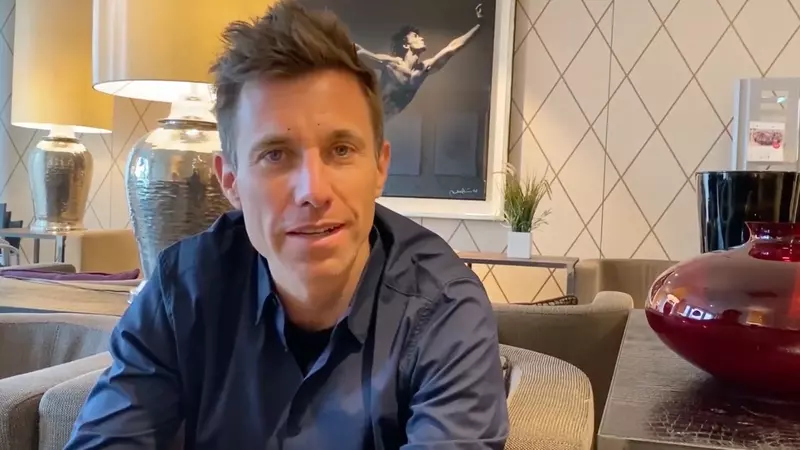
Christian Brugger had laser eye surgery performed by Dr. Breyer to correct his nearsightedness and presbyopia. Since then, he has indeed been able to get by without his progressive lenses. – Why not take a look?




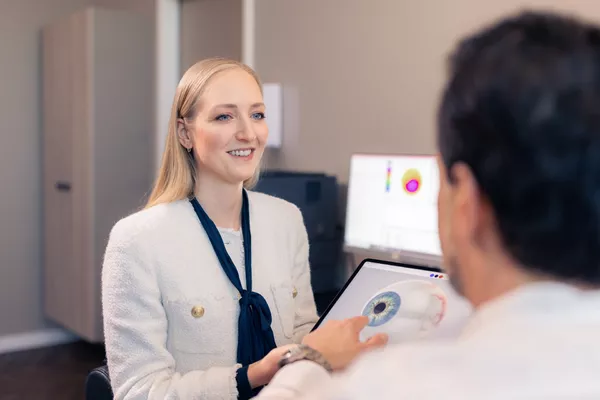

We always recommend the safest and most pain-free procedure for correcting presbyopia to our patients in order to improve their vision and quality of life.
Dr. Detlev R.H. Breyer, FWCRS

Which treatment is best for you?
We can only give you a precise answer to this question after we’ve examined your eyes and determined, for example, whether your natural lens is still clear. In addition, we’ll discuss your expectations for the procedure with you beforehand. Would you like to learn more? If so, please feel free to schedule an appointment for a no-obligation initial consultation or directly for a preliminary examination.
More questions on this topic
-
Unfortunately, there is currently no way to halt or even reverse the aging process of the eye’s lens through special diets, exercise, or medication. It is possible that a healthy lifestyle, which includes a healthy diet, may help slow the process down somewhat overall. But generally speaking, sooner or later everyone will be affected by presbyopia and will have no choice but to use reading glasses.
-
Compared to the risks associated with lens implantation, laser eye surgery carries fewer risks. Even wearing contact lenses for many years carries a higher risk of infection than laser eye surgery. Good to know: At Premium Eyes, we examine your eyes before laser eye surgery using the latest technology, including the Anterion, a swept-source OCT that analyzes the cornea with great precision: its shape, thickness, and optical properties. This supports a reliable diagnosis and monitoring of conditions such as keratoconus. We also examine the posterior segment of the eye—including the retina, the center of the retina (macula), the optic nerve, and the retinal periphery—to rule out any pre-existing conditions and risks. In addition, we’ll ask you a few questions about medical conditions that would preclude laser eye surgery. This provides reassurance for both you and us. Last but not least, we’ll also discuss your expectations regarding your future visual outcome. Learn more about the thorough preoperative examination before laser eye surgery.
Podcasts on Correcting Presbyopia
Learn more in our podcasts with Focus’s top ophthalmologist, Dr. Detlev R.H. Breyer (FWCRS), on the topics of presbyopia, progressive lenses, and corrective procedures.
In the podcast above, he speaks with his patient, sports broadcaster Christian Brugger, about laser eye surgery for presbyopia.
The podcast with his patient Monika Dotzauer focuses on vision correction using premium lenses implanted according to the Düsseldorf protocol. Why not give it a listen?
Podcast with Dr. Breyer and his patient Christian Brugger: Laser eye surgery or will he need progressive lenses soon?
Podcast with Dr. Breyer and his patient Monika Dotzauer: No progressive lenses with premium lenses and the Düsseldorf method.
Lectures by Dr. Breyer on Presbyopia Correction

More patient experiences related to presbyopia
Düsseldorfer Schema mit beeindruckendem Ergebnis, besser als erwartet!
Hohe Myopie (ca. -9/-8) und grauer Star. Nachdem Alltag und Autofahren schwieriger wurden, musste ich mich mit dem Thema OP auseinander setzen. – Dr. Breyer hat viel Ruhe vermittelt, alles erklärt und beantwortet. Einen Teil der Infos und Untersuchungen übernehmen Mitarbeiter, die ich alle als sehr herzlich erlebt habe. Ja, in der Praxis ist viel los, alle sind sehr beschäftigt. Wartezeiten sind aber überschaubar. Als ängstlicher Typ war ich vermutlich etwas nervig und bin heute nur froh, dass ich allen Empfehlung von Dr. Breyer gefolgt bin: OP nach Düsseldorfer Schema, mit Femtosekundenlaser, individuelle Premiumlinsen, keine Vollnarkose, beide Augen mit einem Tag Abstand operiert.
Knapp ein halbes Jahr später sitze ich hier mit einem breiten Grinsen im Gesicht ohne Brille auf der Nase und kann super sehen! – Das Düsseldorfer Schema fand ich erst schwierig. Ich wollte das Beste für meine Augen, aber auch nichts Unerprobtes. Laienhaft ausgedrückt geht es dabei nicht um die Linsen sondern darum, dass sich die Augen gegenseitig unterstützen. Und das funktioniert besser als erwartet: Vorher hieß es, für kleine Schrift würde ich nach der OP eine Lesebrille brauchen. Tatsächlich lese ich Buch/ Zeitung/ PC ohne Brille. Ganz kleine Schrift ist mit +1 Brille entspannter. Ferne ist gar kein Thema. Nur im Dunkeln bei Regen Auto fahren, mache ich noch immer nicht so gerne, wobei die Doppelbilder, die ich vorher hatte weg sind. (...) Ich sage von Herzen DANKE an Dr. Breyer für seine Forschung, Arbeit und freundliche Beratung und an das gesamte Team für die Präzision und die nette Begleitung
Trifokale Linsen – Ergebnis nach drei Jahren immer noch optimal
Ich habe mich vor drei Jahren entschlossen, mich von Herrn Dr. Beyer operieren zu lassen und bin immer noch sehr zufrieden. Im Vorfeld war ich sehr skeptisch, schließlich handelt es sich um eine OP am Auge, also einem äußerst sensiblen Bereich. Ich habe ganze Dissertationen zu dem Thema gelesen, um sachliche Informationen zu erhalten und Risiken abwägen zu können. Hinterher ist man immer schlauer und mich musste feststellen, dass ich mir das hätte sparen können. Ich möchte Herrn Dr. Beyer und seinem Team für die hervorragende Leistung noch einmal herzlich danken. Sie haben mir zu einem neuen Lebensgefühl verholfen.
Break free from your reading glasses today
If you’d like to enjoy the best possible vision without reading glasses or progressive lenses, schedule an appointment now for a free initial consultation with a quick check-up with Dr. Breyer or Dr. Artz. You can do so online, by phone, or by email. We’d also be happy to call you back. We look forward to hearing from you.