Refractive errors and eye conditions
What is Astigmatism?

In astigmatism, the cornea is not round like a sphere but has varying degrees of curvature. This causes both near and distant objects to appear blurry. At the same time, nearsightedness or farsightedness is often present.
What does astigmatism look like?
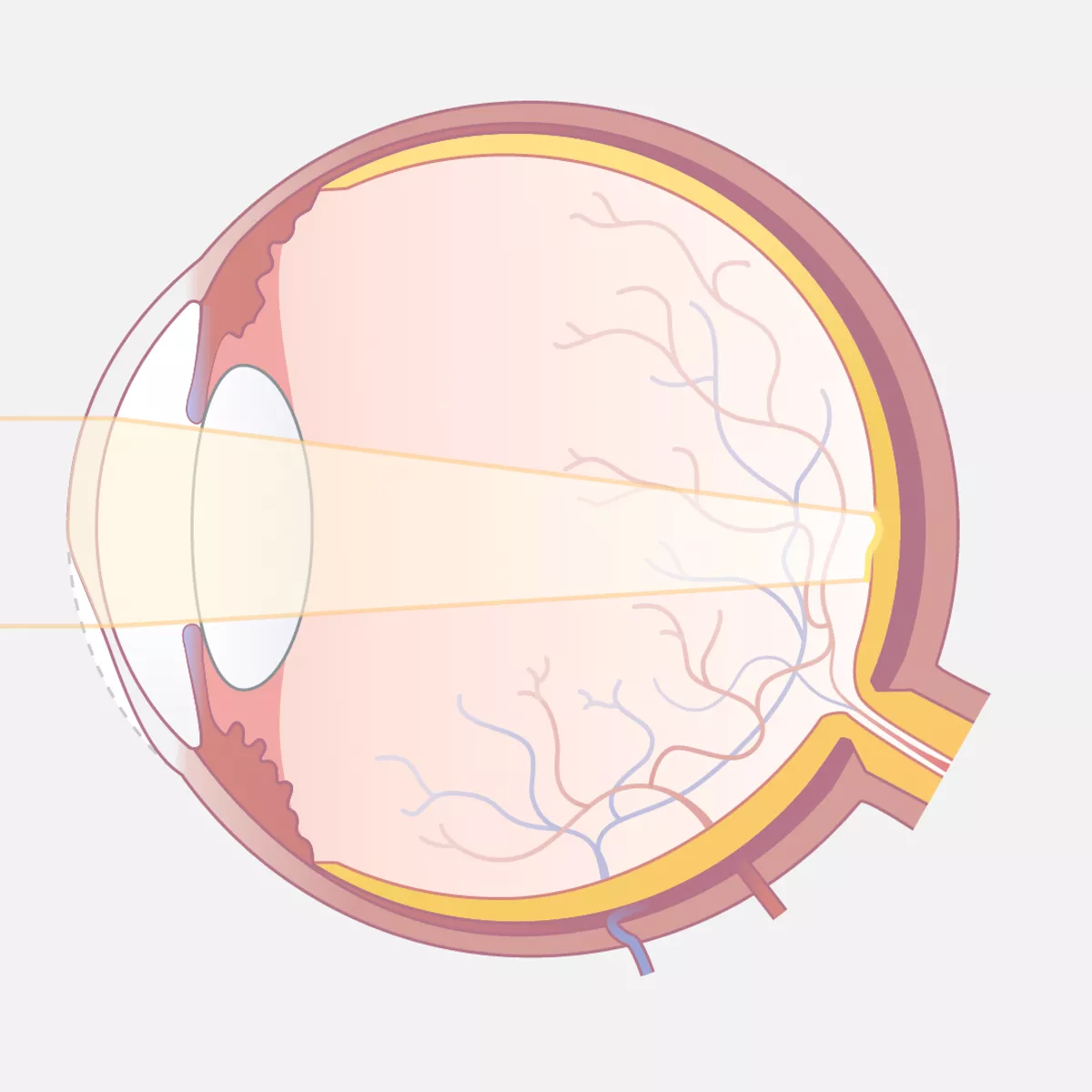
In cases of regular astigmatism, the cornea—part of the eye’s optical system—is not round like a sphere, but has different curvatures, like a dented ball. Light rays traveling vertically are refracted and projected onto the retina differently than those traveling horizontally. As a result, light rays entering the eye in parallel do not converge at a single point on the retina, as they do in an eye with normal vision, but are scattered and often perceived as a line. However, it is not only the front surface of the cornea that contributes to the total astigmatism of an eye, but also its back surface. In addition, there are irregular astigmatisms in which the cornea has several different radii.
The eye’s lens can also have irregular radii on its front or back surface and influence the eye’s total astigmatism.
About 40 percent of all people have astigmatism of 0.5 dpt. For 20 percent, the value is greater than 1 and should be corrected.
Symptoms
How does astigmatism affect vision?
If the rays of light do not strike the retina as a focused beam, objects both near and far appear equally blurry. Since the length of the eye does not play a role in this type of vision problem, astigmatism often occurs alongside nearsightedness or farsightedness.
Typical symptoms of astigmatism
Blurred vision: Objects both near and far appear blurry.
Distorted images: For example, round objects appear elongated.
Light effects: At night, radial light effects are perceived around light sources.
Astigmatism often occurs in combination with nearsightedness (myopia) or farsightedness (hyperopia).
Schedule
an appointment for an eye exam
Diagnostics
How is astigmatism diagnosed?
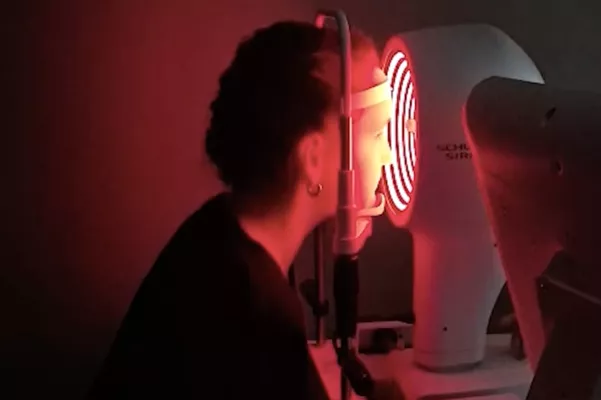
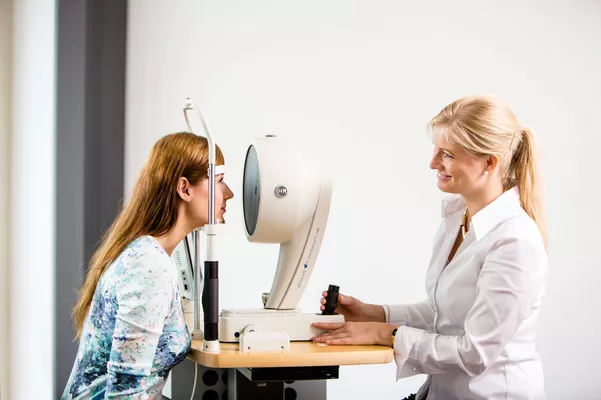
There are various methods available for diagnosing astigmatism. These include the Pentacam, an automatically rotating Scheimpflug camera that measures the anterior segment of the eye, including the radii of curvature of the anterior and posterior corneal surfaces. We also use the Pentacam to determine whether the condition is astigmatism or a disease called keratoconus, which initially presents with similar symptoms. Unlike astigmatism, however, the symptoms of keratoconus worsen over time, and eyeglass prescriptions must be adjusted repeatedly.
The Pentacam examination is already included in the Quick-Check, during which we assess whether you are a suitable candidate for refractive laser or lens treatment.
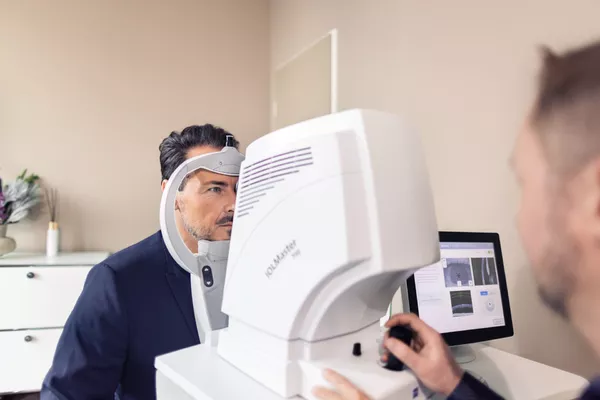
Before refractive surgery, we perform several measurements to calculate the astigmatism very precisely. This includes, for example, a keratometry using the IOL-Master. This process accurately measures both the anterior and posterior surfaces of the cornea. This thorough preliminary examination is a prerequisite for correcting astigmatism. The more precisely it is calculated beforehand, the better the visual outcome.
Laser and lens surgery offers various procedures that can correct both astigmatism and other refractive errors, such as nearsightedness (myopia) or farsightedness (hyperopia), which occur alongside astigmatism. These include, for example, the SMILE Pro laser procedure or Femto-LASIK. The laser can correct astigmatism up to 5 dpt, while Femto-LASIK can correct up to 6 dpt in borderline cases. The exact values also depend on the thickness of the cornea and the other refractive errors to be corrected. This is because a minimum corneal thickness must remain after laser treatment.
For severe refractive errors, implantable contact lenses are a good option. Alternatively, intraocular lens implantation may be considered if, in addition to astigmatism, the patient also has presbyopia or cataracts. To correct astigmatism, so-called toric lenses are required; these are custom-made to precisely compensate for your astigmatism.
Astigmatism can also be corrected on an outpatient basis and painlessly—even when combined with nearsightedness or farsightedness—using laser or lens surgery.
Dr. Detlev Breyer