
Presbyopia
Reading Glasses or Progressive Lenses? Tips and Alternatives
Did you know that starting at age 45, reading glasses, progressive lenses, or multifocal contact lenses become an issue for nearly everyone? That’s when the first symptoms of presbyopia begin to appear: seeing clearly up close becomes increasingly difficult and strains the eyes. This often even leads to headaches.
With reading glasses, you’ll be able to see your smartphone’s display clearly again, and your eyes will feel more relaxed. But what prescription is right for you, and when are progressive lenses or computer glasses a better option? Our eye doctors will give you tips and suggest alternatives.

Why do people need reading glasses or progressive lenses, and at what age?
The optical system of an eye with normal vision is designed so that, with the lens in a relaxed state, we can see distant objects—that is, those about 5 to 6 meters away—clearly. When we look at nearby objects, the incoming light rays must be refracted more strongly so that their focal point lies on the retina. The closer an object is, the greater the eye’s refractive power must be.
In young people, the eye’s lens can become more spherical (accommodation), thereby flexibly increasing the eye’s refractive power by an average of up to 14 diopters. This function of the lens is roughly comparable to a camera’s autofocus, which automatically focuses on the object we are looking at.
However, as we age, the lens loses this ability to accommodate. Starting around age 45, this ability is so limited that the closest point at which sharp vision is still possible (the near point) has already shifted noticeably to medium distances. This is called age-related farsightedness or presbyopia. To still be able to see clearly up close or read, reading glasses are necessary. – The point at which reading glasses become our constant companion depends on many factors, such as visual habits, genetic predisposition, or whether one is already nearsighted, for example.
Our podcast on progressive lenses
Learn more about the most important questions regarding presbyopia, progressive lenses, and corrective procedures in our podcast with Dr. Detlev R.H. Breyer.
How often do you need stronger reading glasses?
As presbyopia continues to progress until the lens has completely lost its ability to focus (accommodation) at around age 60, you will also need to have your reading glasses or computer glasses adjusted several times.
The following values can serve as guidelines for the prescription strength of reading glasses:
45 years: from +0.75 to +1.0 dpt
50 years: from +1.50 to +2.0 dpt
Age 55: +2.25 dpt
Age 60: from +2.25 to +3.0 dpt
For this reason, on average, people need stronger reading glasses at least every 5 years. People who do a lot of close-up work may need new reading glasses even more frequently.
What can you do while driving to see better up close?
If you can no longer see clearly up close, this naturally causes problems when driving: To be able to read the speedometer or the display with navigation instructions, you need reading glasses. At the same time, you have to keep an eye on traffic, which means your distance vision must be perfect. So reading glasses aren’t particularly helpful in this situation.

Driving at dusk or at night can be particularly tricky. The less daylight there is, the worse your near vision becomes. However, presbyopia may also slightly impair your distance vision. This isn’t as noticeable during the day. But at dusk or at night, oncoming vehicles or streetlights can cause glare and halos. The better solution, therefore, would be progressive lenses, which ensure good vision at all distances—or surgical alternatives. Read more about this below.
Multifocal contact lenses as another alternative to reading glasses
Multifocal contact lenses are a classic alternative to reading glasses. They allow you to see clearly at multiple distances. However, a common concern for many contact lens wearers is tolerability. Especially after the age of 40 or 45, some people suffer from dry eyes, which can lead to contact lens-related problems. These include, for example, dry eyes. Furthermore, people who have worn soft contact lenses for many years are significantly more likely to develop microbial keratitis than those who have had laser eye surgery.1
Implantable contact lenses—which are also available with multifocal optics—offer a modern alternative! Our doctors would be happy to advise you.

Why doesn't Dr. Breyer need reading glasses?
Good question! Dr. Breyer is actually at an age when one usually needs reading glasses. For a while, he even had a pair, which he usually kept in his breast pocket so he could put them on just in case.
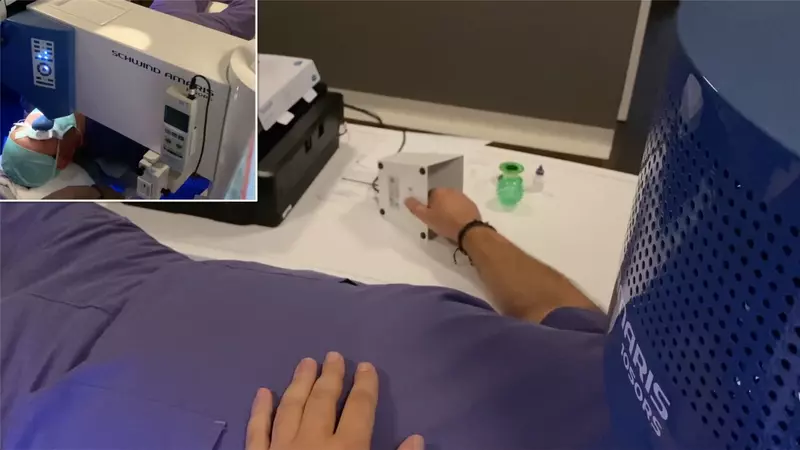
Of course, an eye surgeon rarely needs reading glasses while working, because he uses a microscope instead, which provides much greater magnification than regular reading glasses. But as you can well imagine, an eye surgeon who specializes in refractive procedures—that is, “life without glasses”—is not willing to wear reading glasses. That’s why Dr. Breyer simply had his reading glasses “lasered away.” It really is possible! There are even several methods that make this possible. Dr. Breyer developed the Presby-EDOF-DUS approach for himself. Here’s the video proving it.
Modern Alternatives to Reading Glasses or Progressive Lenses


Do you have any questions about reading glasses and modern alternatives?
If you’re interested in optimal vision without reading glasses, please feel free to schedule an appointment for a no-obligation initial consultation or preliminary examination with Dr. Detlev R.H. Breyer, a Focus Top Physician. You can contact us by phone, email, or online through our website. We’d also be happy to call you back. We look forward to hearing from you.