
Refractive errors and eye conditions
What Is Nearsightedness (Myopia)? – Symptoms and Correction Methods
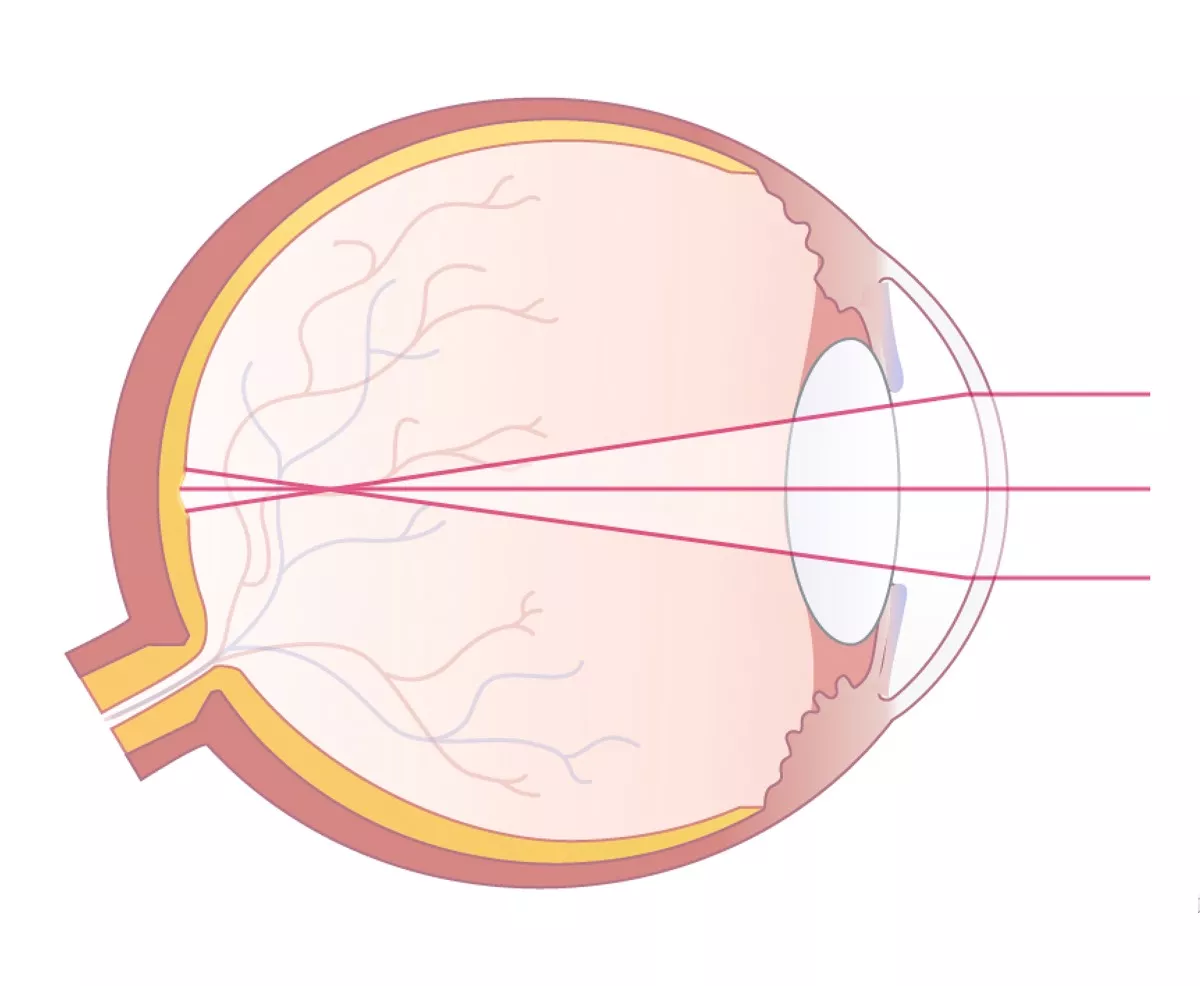
In nearsightedness (myopia), nearby objects appear sharp, while distant objects appear blurry. This is caused either by an eyeball that is too long or by excessive refractive power of the eye. Nearsightedness cannot be cured, but it can be corrected, for example, with glasses, contact lenses, laser eye surgery, or intraocular lens procedures. You can read more about these corrective procedures in the chapter on laser eye surgery for nearsightedness.

Schedule
an appointment to have your visual acuity tested.
Origins
What is nearsightedness (myopia) and how does it develop?
In nearsightedness, the eyeball is too long or the eye’s refractive power is too high. Light rays entering the eye parallel to one another do not focus exactly on the retina, but in front of it. As a result, nearsighted people can still see nearby objects clearly and sharply. The greater the distance, the blurrier the image becomes. People who are nearsighted can often be recognized by the fact that they lean very close to a book while reading or squint when looking into the distance to increase their depth of focus.
Myopia develops during childhood due to excessive longitudinal growth of the eyeball. In addition to genetic predisposition, changes in children’s visual habits play a role: Too much close-up work promotes the longitudinal growth of the eye, while spending time outdoors in daylight helps regulate it. That’s why children should spend about two hours outdoors every day to reduce their risk of myopia.
Myopia research is a specialty of our chief surgeon and retinal surgeon, Prof. Dr. Hakan Kaymak. Among other things, he studies the development and prevention of myopia in children. Important to know: Myopia is partly hereditary, but in children and young adults it is also influenced by visual experience.
Since the length of the eyeball cannot be changed, nearsightedness (myopia) cannot be cured. However, myopia can be corrected on an outpatient basis and painlessly using modern laser eye surgery or through the implantation of contact lenses. You can choose between various laser procedures, contact lens implantation, or—depending on your specific condition—alternative lens surgery procedures. If you’re interested, we recommend scheduling an appointment right away for a free, no-obligation initial consultation with Focus-Top physician Dr. Detlev R.H. Breyer, FWCRS.
Our podcast on “Correcting Nearsightedness and Farsightedness”
In this podcast, Focus’s top medical expert, Dr. Detlev R. H. Breyer, discusses the choice between laser eye surgery and progressive lenses with Austrian sports broadcaster Christian Brugger.
Christian Brugger had laser eye surgery performed by Dr. Breyer to correct his nearsightedness and farsightedness. Since then, he has actually been able to get by without his progressive lenses. – Why not give it a listen?
Laser Eye Surgery for Nearsightedness: Get the Big Picture
Laser Eye Surgery for Nearsightedness (Myopia): Which Procedure Is Right for You? We’ll introduce you to the different procedures and explain their benefits and side effects.

These procedures correct nearsightedness



Schedule an appointment
Nowadays, nearsightedness can be corrected on an outpatient basis and painlessly using laser or lens surgery.
Dr. Detlev R.H. Breyer, FWCRS
Other Procedures



Frequently Asked Questions
-
Laser eye surgery can generally correct nearsightedness up to -10 dpt, farsightedness from +1 to +5 dpt, and astigmatism up to 5 dpt. Some procedures can correct even greater degrees of refractive error. However, for safety reasons, we never perform laser surgery in borderline cases; instead, we would prefer to suggest alternative procedures, such as an ICL or IOL. After a thorough initial examination, we will then recommend one or more methods that are suitable for your eyes.
-
No! With our state-of-the-art laser technology, laser eye surgery is completely painless. Thanks to local anesthetic eye drops, you’ll feel only slight pressure during the procedure. This sensation is roughly comparable to what you feel when you press lightly on your knee with your index finger. Patients generally do not experience any pain after laser eye surgery either. However, there are differences between the procedures. Studies by Prof. Mehta show that all patients find the SMILE method more comfortable than Femto-LASIK.
-
To explain this term, we must first explain what LASIK is. LASIK is an acronym that refers to a procedure in which vision correction is performed in a deeper layer of the cornea, the stroma. This is done using an excimer laser, which reshapes the cornea by vaporizing tissue to alter its refractive power. However, before this can happen, the overlying tissue in this area must be incised in a circular pattern and folded aside like a book cover. This corneal flap is called a flap. It has an average diameter of 9 mm. The flap incision is approximately 20 mm long.
Because this flap incision also cuts through nerve tissue that controls the blood supply to the cornea, dry eyes or a foreign body sensation may occur temporarily or even for a longer period after LASIK. In most cases, these symptoms resolve on their own. However, incorrect incisions are also possible, which can lead to serious complications.
Flap-related side effects such as these do not occur with the SMILE or SMILE pro procedures because this laser eye surgery is performed exclusively with a femtosecond laser—specifically, the VISUMAX 800 (Zeiss). This laser can cut precisely through the upper layers of the cornea into the interior of the cornea. There, a precisely calculated disc of corneal tissue is created, which the surgeon can remove through a minimal 2-mm incision to reshape the cornea in a way that corrects the vision defect. A flap is therefore no longer necessary. Incidentally, with the latest SMILE pro procedure, the laser procedure takes only about 10 seconds.
-
After laser eye surgery, we will examine you the day after the procedure. We will examine you again after one week and/or one month, if necessary.
-
With the new SMILE procedure, the laser treatment itself actually takes only about 10 seconds per eye. The surgeon then removes the lenticule created by the laser from inside the cornea. In total, it usually takes no longer than 10–15 minutes to treat both eyes.
Further Reading
Breyer D.R.H., Kaymak H., Klabe K., Ax T., Hagen P.R., in: Tägliche Praxis 60, 637–651 (2018) pdf, 855.96 KB ›